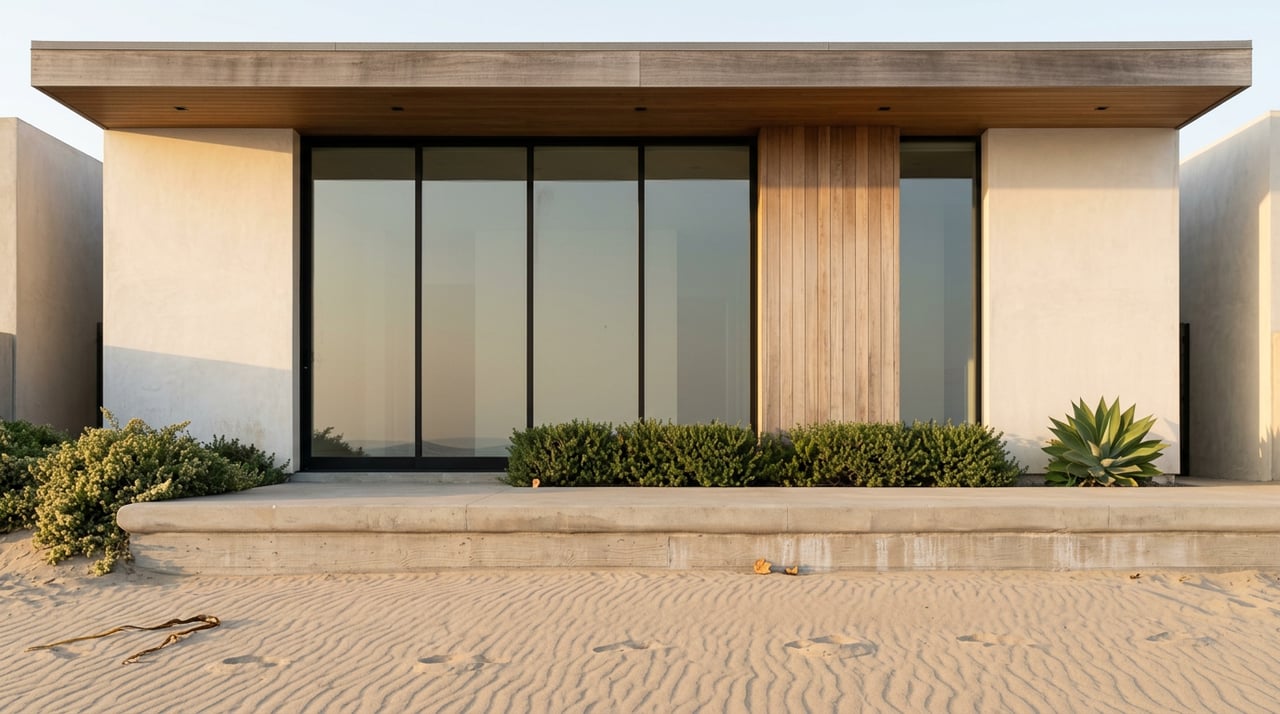
Two houses sit two doors apart on the beach side of Malibu Road. Both were renovated within the last five years. Both look out at the same stretch of Puerco Beach. On paper, a buyer could be forgiven for expecting them to trade within a few hundred thousand dollars of each other. They won't. One sits on a 50-foot lot. The other sits on a 70-foot lot. That 20 feet of recorded frontage, not the kitchen or the primary suite, is what separates them by several million dollars.
That is the mechanism most buyers researching Malibu Road never see coming, and it matters more this year than most, because the road itself is behaving differently from the Malibu narrative dominating the headlines. While much of the city is still measured in permits and cleared lots, Malibu Road is one of the few stretches where the conversation is still about houses, not rebuild timelines.
Two Doors Down, Millions Apart
Malibu Road runs about a mile and a half along the coast, from its eastern entrance near Webb Way to the back gate of Malibu Colony at its western end. It is a single two-lane road, more than 250 oceanfront and near-oceanfront parcels deep, with beachfront homes lining the south side over Puerco Beach and inland-facing homes on the north side backing up to the Malibu Bluffs Recreation Area and the hillsides above.
On the beachfront side, lot width typically runs between 35 and 100 feet of recorded frontage, and that width sets the ceiling on value regardless of what's built on top of it. A 50-foot lot two doors down from a 70-foot lot can differ in true market value by several million dollars even when the homes themselves are comparable. Smaller or older beachfront parcels tend to clear in the high single-digit millions. A clean mid-road parcel prices in the mid-teens. Trophy homes on the widest lots clear above $25 million, and the road's highest closing in the trailing twelve months, at 23832 Malibu Road, sold for $28.5 million.
The road's most cited transaction sits at the extreme end of that spectrum: a Tadao Ando-designed compound that Kanye West bought off-market in 2021 for $57.3 million, then relisted at $53 million in late 2023. The four-bedroom, roughly 4,000-square-foot structure sits on 12 pylons driven 60 feet into the sand, which is its own answer to what a truly rare parcel commands. Most buyers on Malibu Road aren't shopping in that tier, but the same rule applies at every price point below it. Ask what the recorded frontage is before you ask about the renovation.
Where the Ocean Draws the Line
The second number that shapes value on Malibu Road has nothing to do with the county assessor and everything to do with the tide. Under the California Coastal Act of 1976, all wet sand below the mean high tide line is public property held in trust by the state. That line is a legal boundary, calculated as the average of high tides over a 19-year tidal epoch, and it shifts a few feet with the season, generally settling near where the sand stops holding moisture.
Above that line, dry sand can be privately owned, but most Malibu Road parcels carry recorded lateral public easements across part of their dry sand, attached to the original Coastal Development Permits issued when the homes were built. In practice, that means:
- The public can generally traverse the wet sand in front of any Malibu Road home, no matter who owns the parcel above it.
- Many homes also carry an easement that allows lateral foot traffic across a portion of the dry sand, a detail buried in the original permit file rather than the listing sheet.
- Decks, walls, or pool equipment placed seaward of a recorded easement line can trigger California Coastal Commission enforcement, which is one of the first things worth checking before a buyer submits an offer.
None of this shows up in a typical comparative market analysis. It shows up in the title report and the permit history, which is exactly why it gets missed until escrow.
Quieter Than It Looks From the Road
Malibu Road has only two sanctioned public stairways down to the sand, at 24038 and 25120 Malibu Road. Everything else is either a private deeded easement or a lateral walk from one of those two points. Compare that to Carbon Beach, which has three public access points along a similar stretch, and the practical result is that most beachgoers cluster near the two Malibu Road stairways and rarely walk the full length of the road. For a buyer standing on a deck mid-block, that means the beach in front of the house is often quieter than the road's reputation as a busy, celebrity-dense stretch would suggest.
The architectural pedigree along the road backs up its standing. Beyond the Ando compound, one home in the road's beachfront "Sandy Section" was designed by Ray Kappe, the Southern California modernist and SCI-Arc founder, positioned in front of natural rock formations and offshore reefs. Elsewhere on the road, a 7,837-square-foot beachfront lot has plans a year into the city approval process for a 5,879-square-foot residence designed by architect Ryan Levis with interiors by Studio Brinkley. That is not fire-recovery construction. It is the ordinary churn of a high-value street where owners rebuild and redesign on their own timeline, unrelated to any disaster clock.
What the Numbers Are Actually Saying
In the trailing twelve months through May 2026, five single-family homes closed on Malibu Road for a combined $78.4 million, with a median sale price of $17 million. On a road with only four or five closings a year, that median tells you less about the market than it appears to. It mostly reflects which specific homes happened to sell, not a shift in underlying value.
A better read comes from comparing two full rolling twelve-month windows: June 2024 through May 2025 against June 2025 through May 2026. Total sales volume was nearly identical between the two periods, $78.25 million versus $78.375 million, even though the individual homes that traded were different. What moved was speed and confidence. The sale-to-list ratio climbed roughly 27 percentage points year over year, and average days to sell nearly halved. As of May 2026, the road carried 21 active single-family listings, most of them standing, livable homes rather than fire-cleared parcels.
Read together, the message is that Malibu Road buyers are closing faster and closer to asking price than they were a year earlier, on a volume base that has held steady. That is a meaningfully different story than "median price fell," which is the number a quick search will hand you.
A Different Clock Than the Rest of Malibu
Malibu Road's numbers read differently from the rest of the city right now because the rest of the city is still being measured in permits, not prices. In a city update published June 12, 2026, roughly a year and a half after the Palisades Fire, officials reported that building departments had approved ten more home designs and issued six more rebuild permits in the month since May, and that the first beachfront home destroyed in the fire, on Carbon Beach, was only just nearing the framing stage of construction. That is the backdrop against which most Malibu real estate is being marketed this year: staged planning approvals, incremental permits, and construction schedules measured in years rather than months.
Malibu Road isn't carrying that backlog. Every closing in the trailing twelve months traded as a finished, livable home, and the pricing conversation on the road is still about lot width and easement lines rather than plan-check comments and framing schedules. The Ryan Levis project shows the road still sees its own remodels and rebuilds, but those are owner-driven design decisions on standing parcels, not fire-recovery construction working through the city's post-disaster pipeline.
FAQ
Are homes on Malibu Road currently working through the city's fire rebuild process? No. Every home that closed on Malibu Road in the trailing twelve months traded as a finished, standing residence. The multi-year rebuild timelines making headlines elsewhere in Malibu, where as of June 2026 only one beachfront home had reached the framing stage since the fire, apply to cleared, fire-damaged lots working through the city's permitting pipeline, not to the existing housing stock on Malibu Road.
How many homes are actually on Malibu Road? More than 250 oceanfront and near-oceanfront parcels line the roughly mile-and-a-half stretch, split between beachfront homes on the south side and inland-facing homes on the north side near the Malibu Bluffs Recreation Area.
Can the public access the beach in front of a Malibu Road home? Yes, up to the mean high tide line, which is public trust property under the California Coastal Act. Many parcels also carry recorded lateral easements permitting foot traffic across part of the dry sand, tied to the home's original Coastal Development Permit.
The frontage number in a deed and the tide line in a permit file will tell a buyer more about a Malibu Road home's true ceiling than any renovation photo. For a private read on what a specific parcel's width, easements, and access actually support in today's market, Irene Dazzan-Palmer offers a Request a Private Market Valuation, built on three decades of transacting this exact mile and a half of coastline.